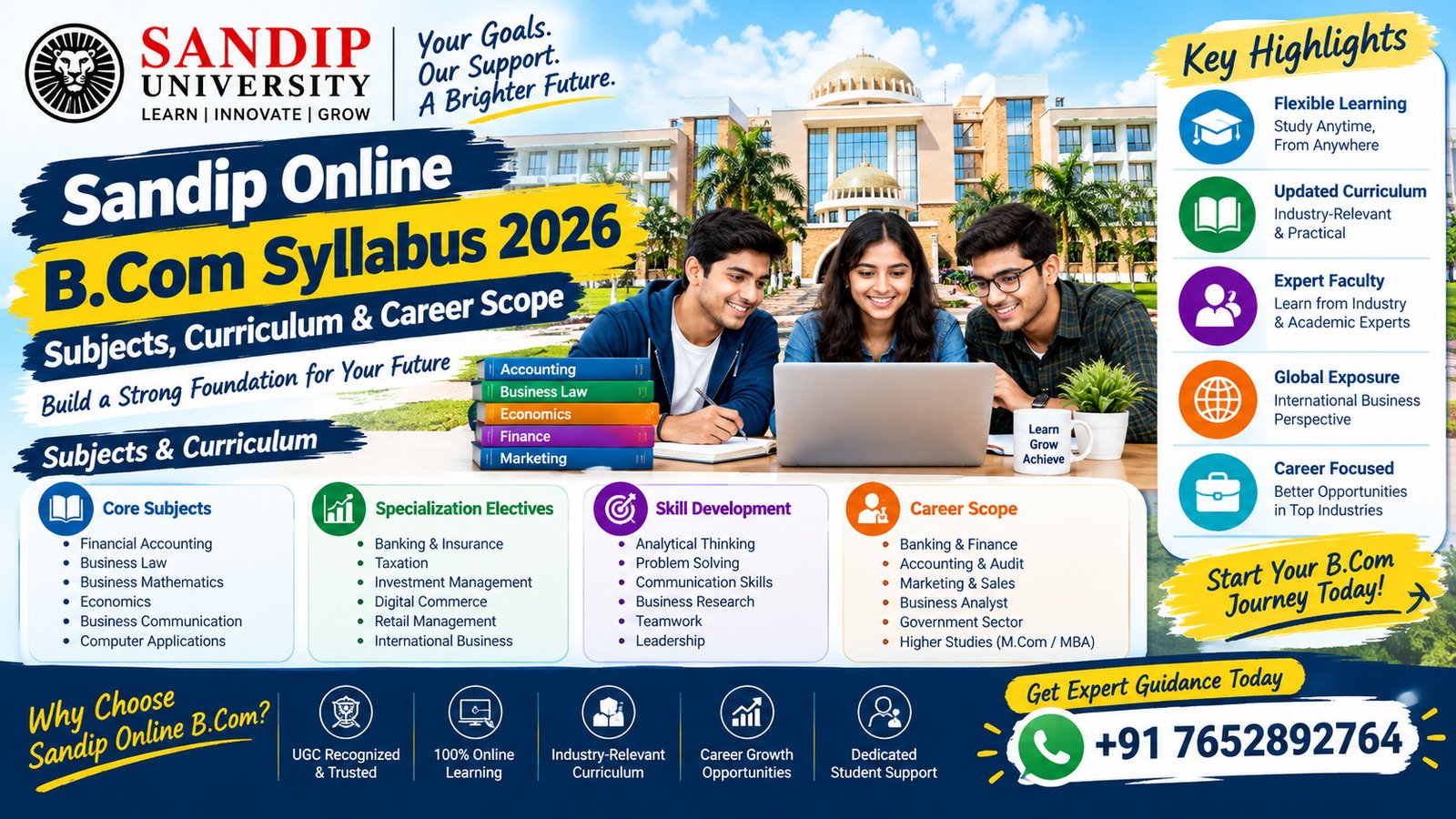
Introduction to Sandip Online B.Com Syllabus 2026
The Bachelor of Commerce (B.Com) is a popular undergraduate degree for students interested in accounting, finance, taxation, business management, banking, economics, and commerce-related careers. As businesses increasingly use digital accounting systems, financial analysis tools, and online business platforms, commerce graduates can explore a wide range of professional opportunities across different industries.
Students searching for the Sandip Online B.Com Syllabus 2026 often want to understand the subjects included in the course, the semester-wise curriculum, eligibility requirements, duration, practical learning opportunities, and career options after graduation.
A typical B.Com curriculum introduces students to financial accounting, business economics, business law, taxation, cost accounting, auditing, financial management, and business communication. Depending on the programme, students may also study entrepreneurship, banking, digital business, management principles, and computer applications.
This guide explains the common subjects covered in a B.Com programme, an illustrative semester-wise curriculum, important skills, possible career paths, and factors to consider before applying for the 2026 academic session.
Important note: The semester-wise subjects in this article are an illustrative B.Com curriculum, not a verified official Sandip University syllabus. Subject names, electives, semester allocation, credits, duration, and delivery mode may differ. Students should confirm the official curriculum and the availability and recognition of the specific programme before applying.
What Is the Sandip Online B.Com Course?
The Bachelor of Commerce is an undergraduate programme designed to develop knowledge of business, accounting, finance, economics, and commercial operations. It helps students understand how organizations maintain financial records, manage resources, evaluate business performance, and comply with applicable regulations.
A B.Com degree may be suitable for students who want to build a foundation in commerce before entering the workforce or pursuing professional qualifications and postgraduate education.
Students considering Sandip Online B.Com 2026 should first confirm whether the specific programme is offered in online mode and review its academic recognition, admission requirements, total fees, learning resources, and examination arrangements.
Key Areas Covered in B.Com
A typical B.Com curriculum may cover the following areas:
- Financial Accounting: Recording, classifying, and summarizing business transactions.
- Business Economics: Understanding demand, supply, markets, and economic decisions.
- Business Law: Learning the legal principles relevant to commercial activities.
- Cost Accounting: Examining business costs and methods of cost control.
- Corporate Accounting: Understanding company accounts and financial reporting.
- Taxation: Learning basic tax concepts and relevant tax procedures.
- Financial Management: Studying budgeting, investment decisions, and financial planning.
- Auditing: Understanding the examination of financial records and internal controls.
- Business Statistics: Using quantitative methods to support business decisions.
- Management Principles: Understanding organizational structures, leadership, and business operations.
The exact subjects depend on the university's approved curriculum.
Sandip Online B.Com Syllabus 2026: Semester-Wise Curriculum
A conventional B.Com programme commonly follows a three-year undergraduate structure, although programme duration and semester arrangements may vary. Some institutions also offer different academic structures under applicable regulations.
The following six-semester outline is an example of how commerce subjects may progress from foundational concepts to advanced accounting, finance, taxation, and business management.
It is not a confirmed official semester-wise syllabus for Sandip University.
Semester 1: Fundamentals of Commerce and Accounting
The first semester generally introduces students to accounting, business organization, economics, and communication. These subjects help learners understand basic commercial activities and the role of financial information in business.
1. Financial Accounting
Financial accounting is one of the core subjects in many B.Com programmes. It introduces the principles and methods used to record and report business transactions.
Students may learn:
- Accounting concepts and conventions
- Journal entries and ledger accounts
- Trial balance preparation
- Cash books and subsidiary books
- Bank reconciliation statements
- Preparation of basic financial statements
- Rectification of accounting errors
This subject helps students understand how businesses maintain financial records and prepare information for decision-making.
2. Business Organization and Management
This subject introduces the structure and operation of business organizations. Students may study different forms of business ownership, organizational objectives, business functions, and management principles.
It helps learners understand how businesses are established, organized, and managed.
3. Business Economics
Business economics explains how economic principles influence business decisions. Topics may include demand, supply, market structures, production, costs, and pricing.
Students develop an understanding of how economic conditions can affect businesses and consumers.
4. Business Communication
Business communication develops written and oral communication skills for professional environments.
Topics may include business letters, reports, email writing, presentations, meeting communication, and professional correspondence.
5. Business Mathematics or Quantitative Techniques
Where included, this subject introduces mathematical tools used in commerce. Topics may cover percentages, ratios, interest calculations, equations, and basic quantitative problem-solving.
6. Accounting Practical Work
Practical exercises may involve preparing journal entries, maintaining ledgers, balancing accounts, and producing simple financial statements.
Learning outcomes: Students build a foundation in accounting, business concepts, economics, and professional communication.
Semester 2: Advanced Accounting and Commercial Principles
The second semester may develop accounting knowledge and introduce commercial law, business statistics, and organizational concepts.
1. Advanced Financial Accounting
Advanced financial accounting expands on the concepts introduced in the first semester.
Depending on the syllabus, students may study depreciation, inventory valuation, preparation of financial statements, accounting adjustments, and selected accounting problems.
These concepts help students understand how transactions are reflected in financial reports.
2. Business Law
Business law introduces legal principles that apply to commercial relationships and business activities.
Potential topics include contracts, essential elements of valid agreements, business obligations, and other commercial law concepts relevant to the programme.
The exact laws and topics depend on the prescribed curriculum and applicable legal framework.
3. Business Statistics
Business statistics introduces methods for collecting, organizing, analysing, and interpreting data.
Students may study:
- Measures of central tendency
- Measures of dispersion
- Correlation and regression
- Probability fundamentals
- Index numbers
- Data presentation and interpretation
These methods help students evaluate information and support business decisions.
4. Environmental Studies or Sustainability
Some undergraduate curricula include environmental awareness and sustainability-related subjects.
Topics may cover environmental challenges, resource management, sustainable development, and responsible business practices.
5. Computer Applications in Business
This subject may introduce business software, spreadsheets, digital documentation, data organization, and basic information systems.
Students may learn how spreadsheets can support calculations, reporting, and routine business operations.
6. Practical Accounting and Spreadsheet Exercises
Students may practise accounting problems, prepare spreadsheet-based reports, and work with basic business data.
Learning outcomes: Students strengthen their accounting knowledge and develop an understanding of commercial law, statistics, and digital business tools.
Semester 3: Corporate Accounting and Cost Accounting
The third semester may introduce more specialized accounting concepts and examine how businesses measure costs and report financial performance.
1. Corporate Accounting
Corporate accounting focuses on accounting practices relevant to companies and other corporate entities.
Depending on the curriculum, topics may include share capital, debentures, company financial statements, and selected corporate accounting transactions.
This subject helps students understand how corporate financial information is prepared and presented.
2. Cost Accounting
Cost accounting examines the costs associated with producing goods or delivering services.
Students may learn:
- Cost classification
- Direct and indirect costs
- Material and labour costs
- Overhead allocation
- Job costing and process costing
- Cost sheets
- Basic cost control techniques
Cost accounting supports pricing decisions, budgeting, and operational planning.
3. Marketing Management
Marketing management introduces the principles used to understand customers and promote products or services.
Topics may include market research, consumer behaviour, product strategy, pricing, distribution, and promotion.
This subject helps students understand the commercial side of business operations.
4. Company Law or Corporate Regulations
Where included, this subject introduces the legal and regulatory framework governing companies.
Students may learn about company formation, governance, directors' responsibilities, and corporate compliance concepts.
The actual topics depend on the approved curriculum.
5. Banking and Financial Services
This subject may introduce the functions of banks, deposits, lending, payment systems, financial institutions, and basic financial services.
Students learn how banking supports individuals, businesses, and the wider economy.
6. Cost Accounting Practical Work
Practical exercises may involve preparing cost sheets, classifying expenses, calculating production costs, and analysing differences between expected and actual costs.
Learning outcomes: Students develop a deeper understanding of corporate accounting, cost analysis, marketing, and banking.
Semester 4: Taxation and Financial Management
The fourth semester may focus on taxation, financial planning, auditing, and the management of business resources.
1. Income Tax Fundamentals
Taxation subjects introduce the principles of income taxation and the calculation of taxable income under the relevant curriculum.
Depending on the prescribed syllabus, students may study income categories, deductions, exemptions, tax calculations, and basic return-filing concepts.
Tax laws can change over time, so students should learn from current course materials and applicable rules.
2. Financial Management
Financial management examines how organizations plan, obtain, and use financial resources.
Potential topics include:
- Financial objectives
- Time value of money
- Capital budgeting
- Working capital management
- Financing decisions
- Cost of capital fundamentals
- Financial planning
These concepts help students understand how organizations evaluate investment and financing decisions.
3. Auditing Fundamentals
Auditing introduces the methods used to examine financial records and evaluate whether information has been prepared appropriately.
Topics may include audit objectives, audit evidence, internal controls, audit procedures, and professional responsibilities.
The detailed content depends on the approved syllabus.
4. Management Accounting
Management accounting focuses on using financial and nonfinancial information to support internal decision-making.
Students may study budgeting, variance analysis, contribution analysis, break-even analysis, and performance measurement.
5. Human Resource Management
Human resource management introduces employee recruitment, training, performance management, workplace communication, and organizational development.
It helps students understand the role of people management in business operations.
6. Taxation and Financial Analysis Exercises
Practical work may include tax calculations based on prescribed examples, financial ratio analysis, budgeting, and interpretation of financial statements.
Learning outcomes: Students gain foundational knowledge of taxation, financial management, auditing, and managerial decision-making.
Semester 5: Advanced Commerce and Business Finance
The fifth semester may introduce advanced subjects and electives that help students explore particular areas of commerce.
1. Advanced Corporate Accounting
Advanced corporate accounting may cover more complex corporate transactions and financial reporting topics.
Depending on the programme, students may study selected company restructuring concepts, financial statement analysis, and other advanced accounting areas.
2. Indirect Taxation
Indirect taxation may introduce the principles of taxes on goods and services, relevant compliance concepts, documentation, and basic tax calculations.
The topics included depend on the applicable law and the prescribed academic syllabus.
3. Financial Markets and Institutions
This subject introduces the structure and functioning of financial markets and institutions.
Students may study money markets, capital markets, financial intermediaries, investment instruments, and the role of financial institutions in the economy.
4. Entrepreneurship Development
Entrepreneurship development explores how business ideas are evaluated and converted into viable ventures.
Potential topics include business planning, opportunity identification, startup finance, marketing, risk management, and enterprise development.
5. E-Commerce and Digital Business
E-commerce examines commercial activities conducted through digital platforms.
Students may study online business models, digital payments, customer experience, e-commerce operations, and the basics of digital marketing.
6. Elective Subjects
Depending on the programme, students may be offered electives in areas such as:
- Banking and insurance
- Investment management
- Entrepreneurship
- Digital business
- Financial markets
- Business analytics
- International business
- Advanced accounting
These are examples of possible elective areas, not a confirmed list of Sandip University B.Com electives for 2026.
Learning outcomes: Students expand their knowledge of finance, taxation, entrepreneurship, and modern business practices.
Semester 6: Strategic Finance and Professional Preparation
The final semester may focus on applying commerce concepts to business decisions, evaluating organizational performance, and preparing for employment or further education.
1. Financial Statement Analysis
Financial statement analysis examines the financial position and performance of an organization.
Students may learn ratio analysis, trend analysis, common-size statements, and the interpretation of financial results.
These techniques can help users assess profitability, liquidity, efficiency, and financial stability.
2. International Business
International business introduces cross-border trade, global markets, international business strategies, and the influence of economic and regulatory conditions on business activity.
Some curricula may include exchange-rate concepts and international trade documentation.
3. Strategic Management
Strategic management explores how organizations define objectives, evaluate their business environment, and develop long-term plans.
Topics may include strategic analysis, competitive advantage, implementation, and performance evaluation.
4. Business Research Methods
Business research methods introduces the process of collecting and interpreting information to investigate business questions.
Students may learn research design, questionnaire development, sampling, data analysis, and report writing.
5. Project Work or Practical Assignment
Some programmes include a final project, internship, case study, or applied assignment.
Potential project ideas include:
- Financial performance analysis of a company
- Comparative analysis of banking services
- Small business budgeting study
- Consumer preferences for digital payments
- E-commerce customer satisfaction
- Working capital analysis
- Study of accounting software in small businesses
- Business plan for a startup
Students should choose projects that match their interests and can be completed using reliable information.
6. Internship or Industry Exposure
Where offered, an internship may help students understand workplace practices and apply academic concepts in a professional environment.
Students should confirm whether an internship is compulsory and whether the institution provides placement assistance.
Learning outcomes: Students learn to interpret business information, evaluate financial performance, and connect academic concepts with practical business situations.
Important: This six-semester outline is illustrative and may not match the actual Sandip University B.Com syllabus. Confirm the official 2026 curriculum before relying on individual subject names or semester placements.
Important Subjects in the B.Com Curriculum
Some subjects form the foundation of commerce education because they explain how organizations manage money, records, customers, employees, and business operations.
Financial Accounting
Financial accounting helps students record business transactions and prepare financial statements. It is useful for understanding the financial position and performance of an organization.
Corporate Accounting
Corporate accounting develops knowledge of accounting procedures relevant to companies and corporate financial reporting.
Cost Accounting
Cost accounting helps businesses understand the cost of products and services, control expenses, and make pricing decisions.
Taxation
Taxation introduces the relevant principles and procedures for calculating tax liabilities and understanding compliance requirements.
Business Law
Business law helps students understand the legal framework surrounding contracts, commercial relationships, and company operations.
Financial Management
Financial management examines how organizations make investment, financing, and working capital decisions.
Auditing
Auditing introduces the principles of examining financial information and evaluating internal controls.
Business Economics
Business economics explains how markets, prices, consumer demand, and economic conditions affect business decisions.
Practical Learning in B.Com
Commerce education becomes more useful when students apply theoretical concepts to realistic business problems.
Depending on the programme, practical activities may include:
- Accounting exercises: Preparing journal entries, ledgers, trial balances, and financial statements.
- Spreadsheet assignments: Using spreadsheets for calculations, financial reports, and data analysis.
- Tax calculation exercises: Applying prescribed rules to sample situations.
- Financial statement analysis: Calculating and interpreting financial ratios.
- Business case studies: Examining business challenges and proposing solutions.
- Research projects: Collecting information and preparing structured reports.
- Presentations: Communicating business findings and recommendations.
- Internships: Gaining workplace exposure where the programme includes this component.
Students considering an online B.Com should check how assignments, practical exercises, faculty support, examinations, and project supervision are delivered.
Sandip Online B.Com Eligibility Criteria 2026
Eligibility requirements depend on the specific programme and the university's applicable admission regulations.
B.Com programmes commonly require applicants to have completed Class 12 or an equivalent recognized qualification. Some programmes accept students from different academic streams, while specific institutions may have minimum percentage requirements or additional conditions.
Students should verify the actual eligibility criteria for Sandip University B.Com admission for the 2026 academic session.
Is Mathematics Compulsory for B.Com?
Mathematics requirements vary by programme. Some B.Com courses accept applicants without mathematics in Class 12, while other specialized commerce programmes may have additional subject requirements.
Applicants should check the official eligibility criteria rather than assuming that mathematics is always compulsory or never required.
Documents Commonly Required for Admission
Depending on the admission process, applicants may need:
- Class 10 marksheet or certificate
- Class 12 marksheet or certificate
- Valid identity document
- Recent passport-size photograph
- Signature image, if required
- Transfer or migration certificate, where applicable
- Additional documents specified by the institution
The institution's current admission checklist should be treated as authoritative.
Sandip Online B.Com Course Duration
A conventional B.Com programme commonly lasts three years and may be divided into six semesters. However, the actual duration and academic structure depend on the approved programme.
Before enrolling, students should confirm:
- Total programme duration.
- Number of semesters and required credits.
- Subjects and elective options.
- Examination and assessment arrangements.
- Project or internship requirements.
- Maximum period allowed to complete the degree.
- Availability and recognition of the programme in online mode.
An online format, where offered, may provide flexibility in accessing learning materials. Students still need to complete the required coursework and assessments.
How Is the B.Com Course Evaluated?
B.Com programmes may use different assessment methods to evaluate students' theoretical understanding and practical skills.
Internal Assessment
Internal assessment may include assignments, quizzes, presentations, case studies, and practical exercises.
Semester Examinations
Semester examinations evaluate understanding of subjects such as accounting, economics, taxation, business law, and financial management.
The format may include objective questions, descriptive answers, numerical problems, or case-based questions.
Practical Assignments
Some subjects require students to solve accounting problems, prepare financial statements, analyse business information, or complete spreadsheet exercises.
Project Evaluation
Where project work is included, assessment may consider research quality, calculations, analysis, report writing, and presentation.
The exact grading structure and weighting depend on the approved academic regulations.
Skills Developed Through a B.Com Degree
A B.Com programme may help students develop skills relevant to accounting, finance, administration, and business operations.
1. Accounting Skills
Students learn to record transactions, prepare accounts, and understand basic financial statements.
2. Financial Analysis
Financial management and accounting subjects introduce methods for evaluating business performance and interpreting financial information.
3. Numerical and Analytical Skills
Business mathematics, statistics, and accounting calculations encourage structured reasoning and numerical accuracy.
4. Taxation Knowledge
Taxation subjects introduce tax concepts and procedures relevant to the programme's curriculum.
5. Communication Skills
Reports, presentations, and business correspondence help students explain information clearly and professionally.
6. Digital Business Skills
Spreadsheet exercises, accounting software exposure, and digital business topics may help students become more comfortable with technology used in commercial environments.
7. Problem-Solving
Case studies and assignments encourage students to evaluate business situations and recommend suitable solutions.
8. Time Management
Managing multiple subjects, assignments, and examinations helps students develop planning and organizational habits.
Career Scope After B.Com in 2026
B.Com graduates may explore opportunities in accounting, banking, finance, taxation support, business operations, administration, and related areas. Job eligibility depends on the employer, the candidate's skills, experience, and any professional qualifications required.
1. Accounts Assistant
Accounts assistants help maintain financial records, enter transactions, organize invoices, and support the preparation of accounts.
Knowledge of accounting fundamentals and spreadsheet tools may be useful.
2. Junior Accountant
Junior accountants may assist with ledger maintenance, account reconciliation, expense tracking, and financial reporting.
Employers may prefer candidates with practical accounting software skills.
3. Banking Operations Executive
Banking operations roles may involve documentation, customer transactions, account services, and routine administrative activities.
Specific roles may require competitive examinations or additional employer training.
4. Taxation Assistant
Taxation assistants may help organize financial records, prepare supporting documents, and assist with tax calculations or compliance-related work under appropriate supervision.
A strong understanding of relevant tax rules and accounting principles is useful.
5. Audit Assistant
Audit assistants may help organize supporting documents, verify financial records, and assist audit teams with routine audit procedures.
The duties depend on the employer and the candidate's qualifications.
6. Financial Services Associate
Financial services roles may involve customer support, documentation, product information, or basic financial operations.
Some positions require additional training, licensing, or specialized knowledge.
7. Business Development Executive
Business development professionals help identify business opportunities, communicate with potential customers, and support sales activities.
Communication, organization, and commercial awareness are important skills.
8. Accounts Payable or Receivable Executive
These professionals support the processing of supplier payments, customer receipts, invoices, reconciliations, and related financial records.
9. Payroll Assistant
Payroll assistants help maintain employee payment records, verify attendance information, and support payroll processing according to company procedures.
10. Entrepreneur or Small Business Owner
Students interested in entrepreneurship may use their knowledge of accounting, costs, budgeting, and business operations to plan and manage a small business.
A B.Com degree does not guarantee a particular job or salary. Practical skills, internships, software knowledge, professional communication, and experience can improve employability.
Higher Education Options After B.Com
Students who want to continue studying after B.Com can explore postgraduate programmes and professional qualifications.
Master of Commerce (M.Com)
M.Com provides further study in commerce, accounting, finance, economics, and related areas. Admission requirements vary by institution.
Master of Business Administration (MBA)
An MBA offers broader study in business management, finance, marketing, human resources, operations, and other management areas. Admission may require an entrance examination or other selection criteria.
Chartered Accountancy (CA)
Students interested in professional accounting and auditing may explore the Chartered Accountancy pathway and its prescribed examinations, training, and eligibility requirements.
Company Secretary (CS)
Students interested in corporate governance, company law, and compliance may consider the Company Secretary qualification pathway.
Cost and Management Accountancy (CMA)
Students interested in cost accounting, management accounting, budgeting, and financial analysis may explore the relevant professional qualification.
Banking and Financial Certifications
Additional training in banking operations, financial markets, accounting software, or financial analysis may help students develop specialized skills.
Data Analytics
Commerce graduates interested in business analytics may learn spreadsheets, SQL, statistics, and data visualization tools.
Students should verify the eligibility and professional requirements of each qualification before enrolling.
Why Consider B.Com in 2026?
Commerce education remains relevant because businesses need people who can manage financial records, understand costs, interpret reports, support compliance, and coordinate business operations.
Potential benefits of a B.Com programme include:
- Foundation in accounting, finance, and economics.
- Understanding of commercial and business principles.
- Preparation for entry-level accounting and administrative roles.
- Opportunities to pursue professional qualifications.
- A foundation for postgraduate study.
- Exposure to digital business and financial tools where included.
The value of the degree depends on programme quality, recognition, practical experience, and how effectively students apply what they learn.
How to Prepare for B.Com Studies
Students can begin preparing for a commerce degree by developing basic numerical, communication, and computer skills.
Revise Basic Mathematics
Practise percentages, ratios, averages, interest calculations, and other basic numerical concepts.
Understand Basic Accounting
Become familiar with income, expenses, assets, liabilities, capital, and the basic accounting equation.
Learn Spreadsheet Skills
Practise formulas, sorting, filtering, formatting, and basic charts in a spreadsheet application.
Develop Business Awareness
Read about how companies operate, generate revenue, manage costs, and make financial decisions.
Improve Communication
Practise writing clear emails, preparing short reports, and presenting information in a structured way.
Explore Accounting Software
Students may gradually explore accounting software used in business settings, depending on access and learning needs.
These activities can make the transition into commerce subjects easier, although they are not substitutes for the institution's formal admission requirements.
How to Choose the Right B.Com Programme
Before applying for Sandip Online B.Com 2026, consider the following factors.
Verify Recognition and Online Availability
Confirm the status of the awarding institution and whether the specific B.Com programme and delivery mode meet applicable regulatory requirements. Recognition of a university does not automatically establish approval for every programme or mode of study.
Review the Official Curriculum
Request the current semester-wise syllabus, credits, elective subjects, practical requirements, and project details.
Check the Total Fees
Review tuition, registration, examination, technology, and other applicable charges. Ask for a clear fee breakdown before making a payment.
Understand Learning Support
For an online programme, confirm how students access learning materials, contact faculty, receive feedback, submit assignments, and obtain technical assistance.
Check Examination Arrangements
Understand how examinations are conducted and whether any practical assessments or in-person activities are compulsory.
Consider Career Goals
Students interested in accounting may prioritize financial accounting, taxation, and auditing. Those interested in banking or finance may focus on financial management, economics, and financial markets.
Students should compare the curriculum with their interests rather than selecting a course based only on its title.
Frequently Asked Questions About Sandip Online B.Com Syllabus 2026
1. What is the Sandip Online B.Com Syllabus 2026?
A typical B.Com syllabus includes financial accounting, business economics, business law, cost accounting, taxation, financial management, auditing, and management subjects. The exact official Sandip University curriculum for 2026 should be confirmed with the institution.
2. How many semesters are there in B.Com?
A conventional three-year B.Com programme commonly contains six semesters. However, the exact duration and structure depend on the approved programme.
3. Is mathematics compulsory for B.Com?
Mathematics requirements vary between programmes. Applicants should check the current admission criteria for the specific B.Com course.
4. Which subjects are important in B.Com?
Financial accounting, business economics, business law, taxation, cost accounting, auditing, and financial management are common core areas in commerce education.
5. Can students from arts or science apply for B.Com?
Some B.Com programmes accept students from multiple academic streams, subject to eligibility conditions. Applicants should confirm the accepted qualifications for their chosen programme.
6. Does B.Com include taxation?
Taxation is a common component of many B.Com curricula, but its subject name, semester placement, and detailed content depend on the approved syllabus.
7. What jobs can students pursue after B.Com?
Possible entry-level roles include accounts assistant, junior accountant, taxation assistant, audit assistant, banking operations executive, and accounts payable or receivable executive.
8. Can I pursue an MBA after B.Com?
B.Com graduates may apply for MBA programmes if they satisfy the relevant eligibility and selection requirements.
9. Is B.Com useful for a career in banking?
B.Com can provide a foundation in accounting, economics, and finance. Specific banking positions may also require competitive examinations, employer selection, or additional qualifications.
10. Is online B.Com suitable for students who need flexibility?
An online programme may be suitable for students who need flexible access to learning resources, provided the specific course is offered in that mode and meets their academic needs. Students should verify recognition, examination arrangements, and student support before enrolling.
Conclusion
The Sandip Online B.Com Syllabus 2026: Subjects, Curriculum & Career Scope is an important topic for students planning undergraduate education in commerce, accounting, finance, and business.
A typical B.Com curriculum begins with financial accounting, business economics, business organization, and communication. It may progress to corporate accounting, cost accounting, business law, taxation, financial management, auditing, and advanced business subjects. Depending on the programme, students may also explore digital business, financial markets, entrepreneurship, and business analytics.
After graduation, students may consider entry-level roles in accounting, banking operations, taxation support, auditing, finance administration, and business operations. Further study or professional qualifications can provide additional pathways for students who want to specialize.
Before enrolling in Sandip University B.Com for 2026, confirm the official semester-wise syllabus, eligibility criteria, fees, duration, recognition, delivery mode, examination format, and admission process.
Planning to pursue B.Com in 2026? Compare the approved curriculum with your career interests, strengthen your accounting and digital skills, and verify the programme details before making an admission decision.